
Client Organization Boundaries for Website Teams
A client boundary must cover every path to data and infrastructure, not just the dashboard. Map users, credentials, servers, backups and recovery responsibilities, then test both allowed and denied access.
Define a client boundary as every place where one client's people, data or infrastructure could be reached from another client's work. Then test that boundary with restricted accounts, including access outside the dashboard. Separate organizations can improve administration, but their names alone do not prove that servers, credentials, logs or backups are isolated.
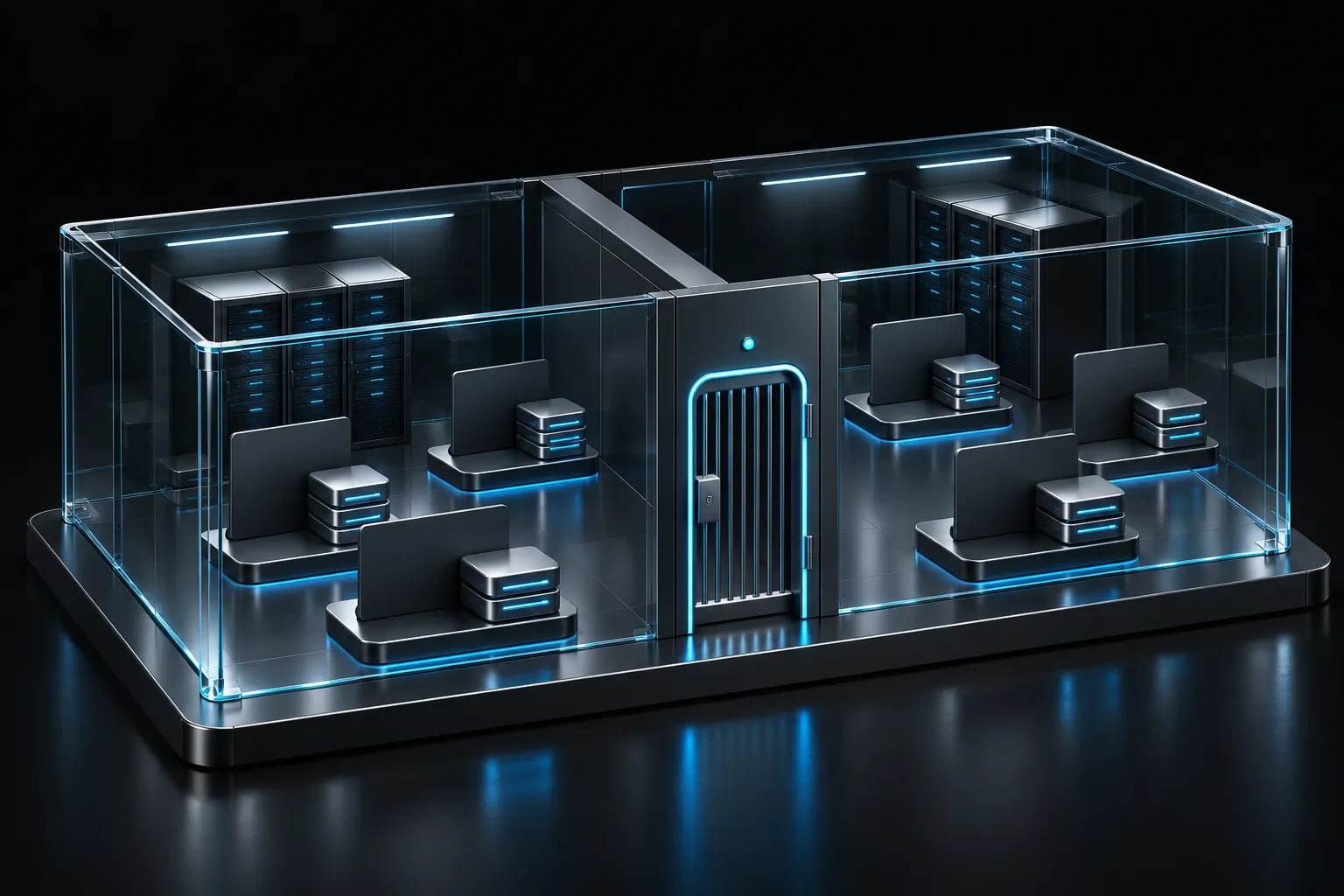
Start with an access map, not a folder name
For each client, identify the legal owner, authorized contacts, production and staging sites, databases, source repositories, cloud accounts, domains and backup stores. Record the people and service identities that can read or change each resource. Include support vendors and temporary contractors, not just the agency's staff.
Draw the path from a person to the application: identity provider, panel, server access, database and any storage account. A panel may hide a client from the interface while a shared administrator credential or cloud account still exposes it. Conversely, separating accounts in the panel does not automatically separate server processes or the billing account.
Assign an owner to each boundary and describe what the owner can approve. If a client requires separate infrastructure, document whether this means a separate operating system, cloud account, backup destination, encryption key or all of them. The more precise the requirement, the easier it is to test and explain its cost.
Why third-party access deserves attention
The Verizon 2025 Data Breach Investigations Report says third-party involvement was present in 30% of breaches analyzed, up from roughly 15% in the previous report. These are report-year observations from Verizon's incident dataset, not the probability that a particular agency or client will suffer a breach.
Third-party involvement in analyzed breaches
Verizon DBIR report year; prior figure approximate
- 2024 report~15%
- 2025 report30%
View chart data
| Item | % of breaches | Note |
|---|---|---|
| 2024 report | ~15% | |
| 2025 report | 30% |
Verizon's report describes its collection and classification methods, and its case mix can vary between years. Third-party involvement is broader than a hosting panel and does not establish that a supplier caused every incident. Treat the figures as a reason to map dependencies and prepare response responsibilities, not as a ranking of providers or a forecast.
Ask each supplier what access it has, how it authenticates staff, what it logs, and how it notifies customers of a security event. Record the answer alongside the permissions you grant. A written commitment is useful, but the agency must still verify its own configuration and restrict the access it controls.
Build a boundary decision table
Use the same table during onboarding and after material changes. Evidence should include the account tested, the attempted action and the result, without recording passwords or sensitive client data.
| Boundary | Control to decide | Test or evidence |
|---|---|---|
| Client organization | Which resources belong to each client? | Inventory checked by the client owner. |
| Human identity | Named accounts and MFA | Each operator signs in separately. |
| Roles | Read, deploy, approve and delete permissions | Attempt an unauthorized change. |
| Server | Shared host or dedicated host | Check host access and escalation paths. |
| Application data | File and database access | Try cross-client access with a restricted identity. |
| Secrets | Client-scoped credentials and recovery | Inventory active tokens and owners. |
| Backups | Destination, encryption and restore authority | Restore a sample in isolation. |
| Logs | Who can view and export records? | Check logs do not expose another client's data. |
| Provider account | Who can create or destroy infrastructure? | Review roles independently of the panel. |
| Offboarding | Revoke access and transfer ownership | Test old access after removal. |
Do not mark a row passed merely because a vendor lists a feature. Agree on a realistic negative test, use non-production data and capture the result. Where a test cannot be performed, record that limitation and the compensating control instead of assuming the boundary works.
Give people only the access their work requires
Use named accounts rather than a shared administrator login so an action can be attributed and one person's access can be revoked without locking out everyone else. Provide a read-only role for stakeholders who only need status, and separate deployment from destructive administration where the tool permits. Review permissions when someone changes role or leaves.
CISA recommends enabling multifactor authentication for accounts that support it. Protect the email and identity accounts used for password recovery as well as the panel itself. Choose phishing-resistant methods when available, maintain controlled recovery options, and do not assume MFA prevents every compromise.
Credentials used by applications and automation are identities too. Give each integration a distinct token where possible, limit its scope and record its owner and rotation procedure. A contractor's personal token embedded in a deployment script becomes an operational and security dependency when that person leaves.
In RunCloud's team documentation, teams control access to infrastructure resources within a workspace. Ploi describes team management for collaborating with server permissions. These descriptions are starting points for a trial, not proof that either product meets a particular client's complete isolation requirement.
Include data, recovery and operational evidence
Backups can cross a boundary even when production accounts do not. Check who can list, download, decrypt and restore each client's backups, and whether a shared destination or shared encryption key changes the risk. Test a restore in an isolated environment with production integrations disabled, then remove the test copy using the agreed retention process.
Logs and monitoring can contain user identifiers, request details or secrets. Decide who can see them and how long they are retained. When a client requests evidence, provide the relevant record without disclosing other customers' data; filtering a report is not a substitute for testing underlying access.
Maintain a break-glass procedure for an unavailable administrator: who can authorize it, where recovery material is held, how access is logged and how credentials are rotated afterward. A stronger boundary that nobody can recover during an emergency is also an operational risk. Exercise the procedure without exposing live secrets.
Onboard, review and offboard as a repeatable cycle
During onboarding, obtain client approval for the asset inventory and access matrix. Create scoped accounts, check MFA and perform a test of an allowed action and a forbidden cross-client action. Document exceptions, their owner and when they will be reviewed.
During operation, reconcile access against the current roster and the services actually in use. Review changes to cloud provider roles, automation tokens, backup access and subcontractors as well as panel membership. After a security incident, agree who investigates, who communicates with the client and who can authorize containment.
At offboarding, transfer the assets and recovery material to the authorized recipient, independently confirm access, then revoke the agency's accounts and tokens according to the agreement. Keep only evidence the contract and applicable retention rules require. The website handover checklist covers this transition in more detail.
Walk through a realistic boundary test
Suppose an agency manages a store for Client A and a brochure site for Client B on a shared machine. Create disposable test sites and accounts, with no real customer information. Assign an operator only to A, then attempt to view B in the dashboard, read B's application files, connect to its database and list its backup objects using only that operator's authorized access.
Record the request, identity, target and result for each attempt. An expected denial is evidence; a missing menu item alone is not, because a direct URL, API token or separate infrastructure account may still permit access. Do not attempt to bypass security controls without written authorization, and stop if the test reaches production data.
Repeat the exercise for a backup administrator and an automation identity. A user who cannot view the live application may still be able to download a complete backup, while a deployment token may retain access after its owner leaves. Treat either finding as a boundary failure until its impact and remediation have been assessed.
If the result is broader than the agreement allows, revoke or narrow the affected access, preserve relevant logs and notify the owner through the agreed channel. Consider separate credentials, storage or infrastructure where the existing platform cannot enforce the required boundary. Repeat the same negative test after the change and record any remaining uncertainty.
For a time-limited contractor, record the requested task, resources, approving client contact and expiry before granting access. Use an individually attributable identity rather than sharing an employee's account. When the assignment ends, revoke the panel membership, associated tokens and independent provider access, then confirm that scheduled automation still works under its intended service identity.
Keep a dated record of who approved each exception and its expiry. When ownership changes, make sure the incoming owner can find the record and understands which access remains intentionally broader than the original design.
For the initial product selection, use the agency panel checklist. Sora Panel is pre-release; read how it works on the homepage and verify any boundary against the eventual released product.
Frequently asked questions
Is a separate workspace the same as a separate server?
No. A workspace may organize access in a control plane while the applications still share infrastructure. Check the architecture and test the specific boundary.
Can an agency share a backup account between clients?
It can, if the risk and contract permit it, but shared credentials can widen access. Test permissions and recovery, and document ownership of the destination and keys.
How often should permissions be reviewed?
Set a cadence that matches the portfolio's risk and contracts, and also review after role changes, supplier changes and incidents. Remove access promptly when it is no longer required.
What if a contractor needs emergency access?
Use an approved, time-limited named account with only the required scope. Record the authorization and revoke both panel and independent infrastructure access afterward.
Sources
- Verizon 2025 Data Breach Investigations Report (viewed 2026-11-29)
- CISA MFA guidance (viewed 2026-11-29)
- RunCloud team documentation (viewed 2026-11-29)
- Ploi team management (viewed 2026-11-29)
- Sora Panel homepage (viewed 2026-11-29)
Sora Panel is not released yet. Read how it works on the homepage.